Clinical Applications
BSHAS in Clinical Practice
The Beach Safety Hierarchy Assessment Scale was built for the gap the clinical literature has not yet filled: a partner-facing, real-time measure of nervous system readiness in trauma-affected intimate relationships.
The Clinical Gap
There is extensive literature on DID treatment. There is almost nothing on what the intimate partner should do — and almost nothing that gives the non-clinical partner a usable framework for real-time relational assessment.
Existing partner psychoeducation tells partners what to be: patient, consistent, educated. Phase-oriented trauma treatment tells clinicians when to push and when to hold. Neither gives the partner or the clinician a shared metric for what the nervous system can actually hold in the next ten minutes.
The BSHAS was developed to fill that gap. It is not a diagnostic instrument. It is an assessment tool for relational calibration: giving the partner — and the clinician — a common language for what level the system is operating at, and what is and is not available at that level.
What the BSHAS Measures
The Beach Safety Hierarchy Assessment Scale is a 25-item self- and partner-report instrument measuring five levels of nervous system readiness for relational engagement. It yields:
- Five subscale scores (one per level) on both self-report and partner-report forms
- A within-pair concordance metric indicating where both partners agree on current level, and where they diverge
- Level position across both forms — identifying the agreed level and highlighting significant discordance
The high within-pair concordance (r = .73–.85) confirms that self-report and partner-report are assessing a shared underlying nervous system state, not merely projections. Both informants are seeing the same thing. The BSHAS gives them a common vocabulary for it.
Full psychometric details are available in the open-access preprint: doi.org/10.5281/zenodo.19688087
Clinical Applications
Couples Therapy with DID
Administer as a pre-session or between-session measure. Both partners complete separate forms; the clinician receives a joint level picture before the session begins. Significant L3/L4 discordance — partner believes Level 4 is active; client is at Level 3 — is the most common clinical finding and the most predictive of session rupture.
Partner Psychoeducation
The five-level model gives partners a vocabulary for what they are observing that does not require clinical training to use. Rather than “she was triggered,” the partner learns to name the level, understand what is available, and respond accordingly. This reduces the interpretive damage — the narrative partners build about why a conversation collapsed.
Phase-Oriented Treatment Planning
The hierarchical structure maps directly to phase-oriented trauma treatment. Use BSHAS level position as a measurable marker of readiness to advance between phases. Collapse in level position is an early indicator of trauma processing overload before clinical deterioration is otherwise visible.
Pre-Session Readiness Assessment
A brief partner-report form administered in the waiting room gives the clinician a real-time picture of where the couple is arriving — not where they report being. Significant divergence between self-report and partner-report at intake is a clinical signal worth noting before the session begins.
Phase-Oriented Treatment Mapping
The BSHAS hierarchy maps directly to the phase-oriented framework (van der Hart et al., 2006; Herman, 1992) used in most evidence-based DID treatment protocols:
Phase 1 — Safety & Stabilization
Affect regulation, crisis containment, grounding, daily functioning, internal system communication. The work of this phase is making Levels 1–3 accessible and stable.
BSHAS Levels 1–3
Physiological Safety, Emotional Safety, Relational Safety. Phase 1 work is complete when Level 3 is accessible under moderate relational stress without collapsing to Level 1.
Phase 2 — Trauma Processing
Trauma memory processing, abreaction management, EMDR or other processing modalities. Requires sustained access to cortical processing capacity.
BSHAS Level 4
Cognitive Engagement. Phase 2 readiness requires that both the client and clinician can sustain Level 4 for the duration of trauma processing without dropping into Level 3 or below under moderate activation.
Phase 3 — Integration
Identity integration, grief work, relational repair, reconnection with ordinary life. Requires mentalizing capacity and the ability to hold contradictory experience simultaneously.
BSHAS Level 5
Reflective Integration. Level 5 is the functional correlate of mentalizing. Phase 3 work becomes accessible when Level 5 is available without triggering collapse. Note: Level 5 carries a distinct collapse risk not present at lower levels.
Theoretical Grounding
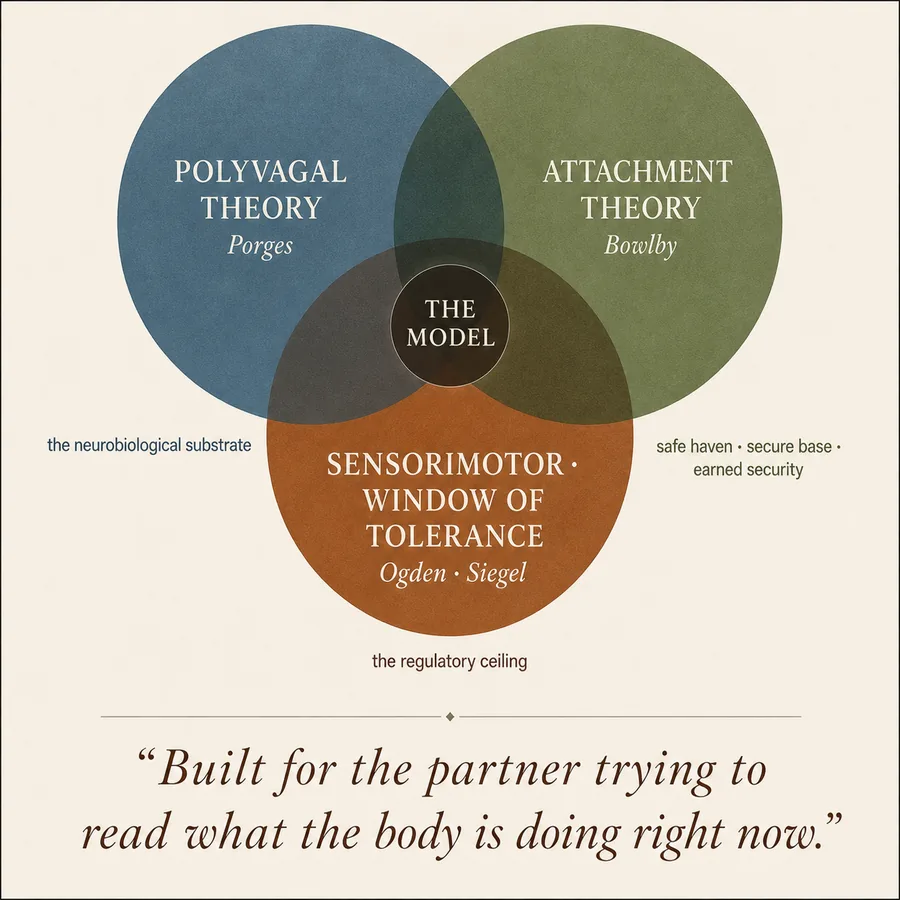
The BSHAS synthesizes four established bodies of peer-reviewed research, each contributing a distinct component of the assessment structure:
Access & Research Collaboration
Preprint
Full manuscript: development, factor structure, preliminary validation, and clinical applications. Open access, CC BY 4.0.
Download Free →Zenodo · doi.org/10.5281/zenodo.19688087
Request the Instrument
The 25-item BSHAS with parallel self-report and partner-report forms is available for non-commercial research and clinical use. Contact Scott Beach directly.
Clinical Inquiries
Consultation on BSHAS implementation, couples therapy protocol, partner psychoeducation curriculum, or pre-session readiness procedures.
Research Collaboration
Seeking co-investigators for: longitudinal validation with clinical DID samples, intervention development, clinical-sample replication, and couples therapy outcome measurement using BSHAS as pre/post measure.