Clinical Overview
What Is Dissociative Identity Disorder?
Formerly known as multiple personality disorder — what DID actually is, how it develops, how common it is, and what it means for intimate relationships.
The Clinical Definition
DID is not primarily a disorder of “multiple personalities” in the popular sense. It is the structural result of a developmental process — the normal integration of identity in childhood — that was interrupted by overwhelming, repeated trauma before the developing brain had the capacity to process and integrate experience coherently.
Diagnostic criteria require all of the following:
- Two or more distinct personality states that recurrently take executive control of the person’s behavior, speech, or actions
- Significant gaps in memory for everyday events, personal information, or traumatic events, beyond ordinary forgetting
- Significant distress or impairment in social, occupational, or other areas of functioning
- Not attributable to substance use, another medical condition, or broadly accepted cultural or religious practices
The diagnostic criteria describe what can be observed. They do not describe what DID actually is. The most clinically useful understanding is structural: DID is what happens when the personality, under conditions of overwhelming early trauma, cannot complete the developmental integration that is normal in childhood. Instead of one continuous self with access to a full range of experience, the person develops a system of functionally distinct parts — each carrying different memories, affects, behavioral repertoires, and relational orientations.
This is not a broken mind. It is a side effect of a natural protective mechanism that was never allowed to turn off.
How DID Develops
The Structural Dissociation of the Personality model (van der Hart, Nijenhuis & Steele, 2006) provides the most clinically useful framework. Under conditions of overwhelming early trauma, the integrative capacity of the developing personality is insufficient to process the experience as a unified whole. The personality divides along functional lines:
Apparently Normal Part (ANP)
The part that manages daily functioning — work, relationships, the surface of life. Typically has limited access to traumatic memory. May have amnestic gaps for what other parts do or experience. In DID, there may be more than one ANP.
Emotional Parts (EP)
Parts organized around traumatic experience and survival-based responses: fight, flight, freeze, submit, attach. These parts intrude into daily consciousness as flashbacks, emotional reactions, behavioral shifts, and somatic experiences that feel foreign to the ANP. In DID, there are typically multiple EPs.
In DID, this structural division is more complete and more elaborated than in single-episode PTSD. Multiple EPs develop, each associated with different trauma contexts and survival responses. The result is a system of personality states with varying degrees of coordination, amnesia, and mutual awareness.
The Developmental Window
DID is almost always associated with severe, repeated trauma that begins before age 9 — before the brain’s integrative capacity is sufficiently developed. The mechanism is not pathological: dissociation is a normal, protective response to overwhelming experience. DID is what happens when a child’s entire developmental trajectory is organized around that protective response because the overwhelming experience does not stop.
Common origins include: childhood sexual abuse, physical abuse, severe neglect, early attachment trauma, repeated medical trauma without adequate support, and witnessing domestic violence.
How Common Is DID?
DID is more common than the clinical field’s treatment of it would suggest. Prevalence studies place it at approximately 1–3% of the general population — making it more common than schizophrenia.
Conservative estimates, using the lower bound of 1% and accounting for significant underdiagnosis, suggest approximately 1.5 million Americans are currently living with DID without an accurate diagnosis. The average individual with DID spends 7 years in the mental health system before receiving an accurate diagnosis — frequently receiving incorrect diagnoses of bipolar disorder, borderline personality disorder, schizophrenia, or treatment-resistant depression along the way.
The underdiagnosis rate reflects clinical unfamiliarity, the often subtle presentation of DID (state shifts are frequently non-dramatic), and the absence of standardized screening in most clinical settings.
Common Misconceptions
Public understanding of DID is largely shaped by fictional portrayals that bear little resemblance to the clinical reality. The following reflects what the research actually shows:
| Common Misconception | Clinical Reality |
|---|---|
| DID looks like dramatic, theatrical shifts between personalities | State shifts are typically subtle — changes in tone, vocabulary, affect, body posture, or relational orientation. Many people with DID go undetected for years in clinical settings. |
| People with DID always know when they switch | Amnesia between states is a core feature of the diagnosis. Many people have no conscious awareness of other parts or what those parts do. |
| DID is rare and dangerous | DID occurs in approximately 1–3% of the population. Most people with DID are not dangerous — they are frightened. The condition is associated with significant suffering, not violence. |
| People with DID have completely separate, fully formed personalities | The parts are functionally distinct self-states, not complete separate people. They share a body, often have overlapping awareness, and exist on a spectrum of elaboration and autonomy. |
| DID can be cured with the right therapy | Integration is one therapeutic goal, but not the only one. Many people with DID live functional, meaningful lives with increased internal cooperation between parts, without full fusion. Reduction in suffering and improved functioning are the primary aims. |
| Partners can identify all the alters by name and interact with them directly | Many parts never present overtly. Partners frequently observe the influence of other states without ever “meeting” them directly. The system is internal; the partner’s experience is of behavioral and affective shifts, not theatrical character changes. |
DID and Intimate Relationships
The clinical literature has extensive coverage of DID treatment. It has almost nothing on what the intimate partner should do — which is the gap the Beach Safety Hierarchy was developed to address.
Partners of individuals with DID face a challenge that has been named but not solved: how to calibrate relational behavior to a nervous system whose capacity for engagement shifts in real time, sometimes across multiple states with different relational orientations, memory access, and emotional needs.
Standard relationship guidance — “communicate openly,” “be patient,” “express your feelings clearly” — frequently produces the opposite of its intended effect when the partner’s nervous system is not at a level where that kind of engagement is accessible. This is not a failure of love or commitment. It is a mismatch between the relational tool and the actual state of the nervous system.
The most common partner complaint is not “she’s too difficult.” It is: “I never know what to do.”
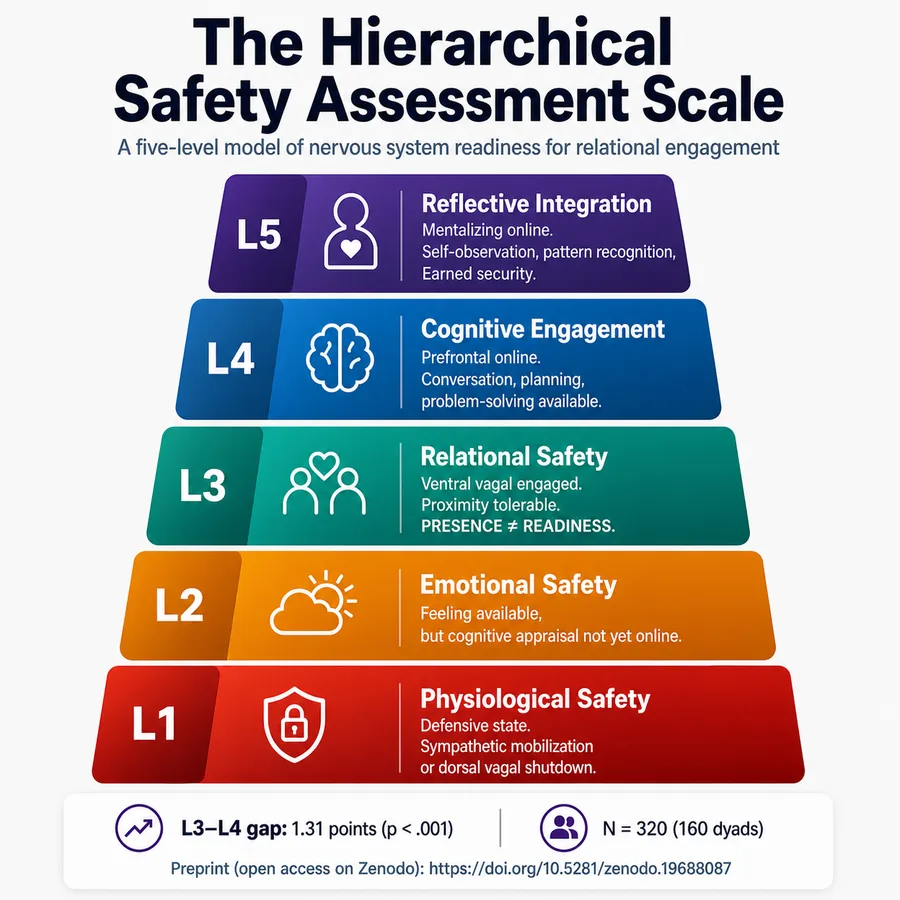
The Beach Safety Hierarchy provides a framework for answering that question. Rather than asking “what should I say?” — the partner learns to ask first: what level is she at right now, and what can that level actually hold? The answer determines not what to do, but what is possible to do.
For a full account of how the model applies to the partner experience, see the For Partners section of this site and the applied reading at leadwithsafety.com.
Applied Reading
The following articles at leadwithsafety.com apply the clinical concepts on this page to the lived experience of being in an intimate relationship with a person with DID or complex trauma:
The mechanism behind DID: why the mind creates walls, and what those walls are actually protecting.
DID explained for the partner who is trying to understand the system they are in a relationship with.
The nervous system does not consult intent before responding. Understanding this changes the entire relational frame.
When your partner is not in the same moment you are — and what that means for how you reach her.
A practical walkthrough of the hierarchy and what each level looks like from the partner’s side of the room.
Love is necessary. It is not sufficient. The variable that changes everything is not how much you love her.
Clinical References
- International Society for the Study of Trauma and Dissociation (ISSTD) — Clinical guidelines, training, and research for DID treatment
- American Psychiatric Association. (2022). Diagnostic and Statistical Manual of Mental Disorders, Fifth Edition, Text Revision (DSM-5-TR). 300.14 Dissociative Identity Disorder.
- van der Hart, O., Nijenhuis, E.R.S., & Steele, K. (2006). The Haunted Self: Structural Dissociation and the Treatment of Chronic Traumatization. W.W. Norton.
- Putnam, F.W. (1989). Diagnosis and Treatment of Multiple Personality Disorder. Guilford Press.
- Şar, V. (2011). Epidemiology of dissociative disorders: An overview. Epidemiology Research International.
- Brand, B.L., et al. (2016). Separating fact from fiction: An empirical examination of six myths about dissociative identity disorder. Harvard Review of Psychiatry, 24(4), 257–270.
- Porges, S.W. (2011). The Polyvagal Theory. W.W. Norton.
- Beach, S. (2026). The Beach Safety Hierarchy Assessment Scale (BSHAS): Development, factor structure, and preliminary validation. doi.org/10.5281/zenodo.19688087