Partner Resources

Loving Someone with DID

Why the tools you have do not work the way they are supposed to — and a framework for understanding what the nervous system can actually hold right now.

Why Good Advice Fails

You already know something is wrong with the advice you have been given. You have tried the communication strategies. You have practiced what the therapists told you to do. Sometimes it works. Sometimes it makes everything worse. You cannot figure out why.

The problem is not your technique. The problem is timing.

Conventional relationship guidance assumes a baseline: a nervous system that, at rest, has access to the social engagement system, can process incoming communication, and can respond with some degree of regulatory capacity. In a relationship with a person with Dissociative Identity Disorder or complex trauma, that baseline is not guaranteed. It is a ceiling — a best case — not a floor.

When you try to have a difficult conversation while your partner’s nervous system is in physiological defense, the words you say are not experienced as communication. They are processed as threat data. The apology you offer is not heard as repair. It is heard as confirmation that something is wrong — which to a nervous system organized around danger means: threat incoming.

This is not a character flaw. It is not a choice. It is polyvagal neurobiology operating exactly as it is designed to operate in a system that was built around chronic early trauma.

The same words that open a conversation at Level 4 collapse a conversation at Level 2. The tool is not wrong. The level is.

The Five Levels — From the Partner’s Side

The Beach Safety Hierarchy describes five levels of nervous system readiness. Here is what each level looks like from where you are standing, and what is actually available to you at each one.

1
Physiological Safety

What You See

Shutdown, dissociation, flat affect, rigid body, or activation and anger without an apparent cause. May look like she is “not there.” May look like sudden fury. Both are the nervous system in defensive mode.

What Is Available

Reduce stimulation. Quiet your own nervous system first. Physical proximity without demands. Very few words. No logic, no explanations, no emotional appeals. Your calm is the only tool that works at this level.

2
Emotional Safety

What You See

Emotion without logic — crying or anger that feels disproportionate to the situation. She can express what she feels but cannot think about it or hear your perspective through it.

What Is Available

Validation without problem-solving. “That makes sense” does more work here than any explanation. No reframes, no corrections, no pivoting to your own experience. Just name what you see: “You’re really hurting right now.”

3
Relational Safety — The Level Most Misread

What You See

Your partner seems calm. She is making eye contact, responding, seems present. This looks like readiness. The research shows it measurably is not. This is the level that produces the most damaging relational misfires.

What Is Available

Warmth, closeness, simple relational contact. What is not available: the hard conversation, the decision you need to make, the thing that happened last Tuesday. Wait. The window is still coming.

4
Cognitive Engagement

What You See

She can hear you and think at the same time. Conversation about the relationship is possible. Planning, problem-solving, deciding something together — all available. This is what you have been waiting for.

What Is Available

The actual conversation. The thing that needed to be said. Repair. Conflict resolution. Decisions. Bring it here, not at Level 3.

5
Reflective Integration

What You See

She can observe her own patterns with curiosity. Connect past to present. Hold something contradictory as true at the same time. This is rarer and more fragile — but it is when real insight and internal change become accessible.

What Is Available

Deep relational conversation. Meaning-making. The kind of exchange that actually changes something. Carry it lightly — this level collapses under pressure more readily than Level 4.

The Finding That Changes Everything

1.31 points — p < .001 — N = 320

The gap between Level 3 (calm and present) and Level 4 (ready to think together) is real, it is measurable, and it is invisible to most partners. The moment she looks most ready for the hard conversation is statistically a moment when the cognitive processing to hold it is often not yet there.

What This Changes

You stop having the conversations at the wrong time. That alone eliminates a significant portion of the damage — not because you become more patient, but because you understand what the nervous system can hold right now.

Patience implies waiting for her to change. The hierarchy changes the frame: you are not waiting for her to calm down. You are reading what level she is at and choosing your move accordingly. That is an entirely different posture.

You stop interpreting Level 3 calm as readiness and being blindsided when the conversation collapses. You stop taking the collapse personally, because you understand the mechanism that produced it.

You also stop waiting to regulate yourself until after things go wrong. Your nervous system is the ceiling of safety her nervous system has access to in any given moment. A partner operating outside their own window of tolerance cannot offer a regulated environment — even with the best intentions. Regulating yourself first is not the compassionate thing to do. It is the only thing that works.
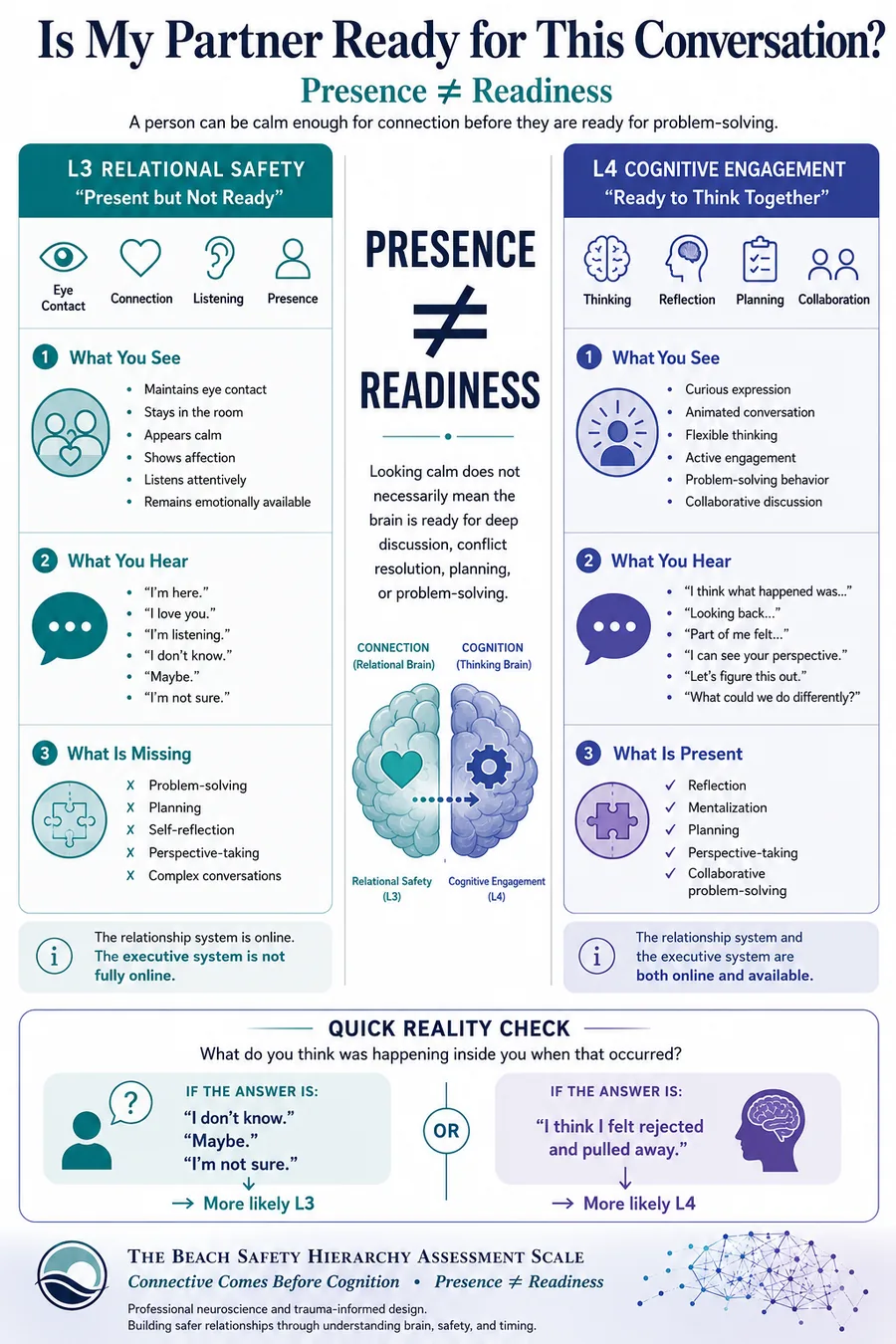
Is My Partner Ready for This Conversation? The L3/L4 distinction — what you see vs what is actually available

For the full research behind this framework, see the BSHAS preprint (open access, doi.org/10.5281/zenodo.19688087).

Applied Reading

The following articles at leadwithsafety.com take the clinical framework on this site and put it into the lived experience of being the partner in the room:

Why Love Alone Is Not Enough

Love is necessary. It is not sufficient. The variable that changes everything is safety, not affection.

Why Her Reactions Look Like Choices — But Are Not

The nervous system does not consult intent before responding. Understanding this reframes everything.

Trauma Time and Present Time

When she is not in the same moment you are — and what it means to try to reach her across that gap.

The Five Levels of Safety Every Partner Needs to Know

A practical walkthrough of the hierarchy at the kitchen table level.

Regulating Yourself First

You cannot regulate her nervous system. You can only regulate your own — and in doing so, change what her system has to respond to.

What Is Dissociation?

The mechanism behind DID: why the mind creates walls, and what those walls are protecting.

The Book

Lead with Safety

A Husband’s Guide to Loving a Wife with DID

The clinical framework on this site provides the backbone of Lead with Safety — a narrative nonfiction book for the non-clinical partner of a person with DID or complex trauma. Eighteen chapters. 52,000 words. What the levels look like at the kitchen table, at 11 p.m., in the middle of a conversation that just collapsed.

The BSHAS is the research instrument. The book is what it feels like to actually live inside it.

Visit leadwithsafety.com →